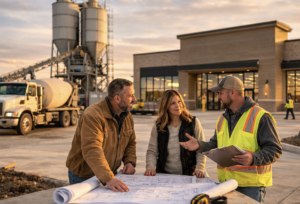
Opening, expanding, or upgrading a retail store in North Dakota takes more than shelving, signage, and inventory. It takes a physical property that can handle weather, traffic, delivery demands, customer expectations, and long-term maintenance without becoming a drain on the business. That is exactly why a North Dakota retail store would need the services of a North Dakota concrete batch plant. In a state where retail activity is shaped by local growth, development patterns, tourism spending, and changing consumer traffic, dependable concrete is not just a construction material. It is part of the business strategy.
North Dakota continues to show signs of retail movement and investment. The state’s Tax Commissioner reported that retail trade grew by 2.5% in the 2025 year-end taxable sales data, while construction also posted growth. At the same time, business openings, retail relocations, and continued visitor spending show that North Dakota businesses still need durable sites that are built to last. Retailers are operating in an environment where site quality, access, safety, and appearance matter more than ever. That makes the relationship between a retail store and a local concrete batch plant far more important than many people realize.
A Retail Store Needs a Strong Foundation Before It Can Serve Customers
Every retail store starts with the site itself. Whether the property is a small standalone shop, a strip-center space, a garden supply store, a farm-and-ranch retailer, or a regional big-box location, the quality of the concrete on the property affects how the business functions every day. A North Dakota concrete batch plant supplies the concrete used for foundations, floors, sidewalks, curbs, pads, loading zones, dumpster enclosures, and parking areas. These are not minor details. They influence safety, usability, drainage, durability, and the customer’s first impression.
North Dakota’s climate makes this even more important. Concrete used in a retail setting has to stand up to freeze-thaw cycles, plowing, de-icing, vehicle traffic, and delivery trucks. A poorly planned or poorly supplied concrete job can crack early, settle unevenly, or create drainage issues that hurt both appearance and operations. A local North Dakota concrete batch plant is valuable because it understands regional conditions, delivery logistics, and the kind of mix performance commercial projects need in this state. That local knowledge helps retail owners build smarter from the beginning. General state context and economic background can be found through Wikipedia’s North Dakota overview.
Retail Growth Depends on Properties That Are Ready for Traffic
Retail is about access. If customers cannot enter safely, park easily, walk comfortably, and move around the property without frustration, the store starts losing opportunities before a sale even begins. Concrete plays a major role in that customer experience. Sidewalks, ramps, entrances, aprons, curbs, crosswalk approaches, and parking lot sections all affect how inviting and functional the location feels.
That matters in North Dakota because retail is still active, but it is also competitive. The North Dakota Retail Association tracks issues affecting merchants across the state, and local business coverage continues to show market movement in cities such as Fargo and Bismarck. In Fargo-Moorhead, new business openings and commercial projects remain part of the development picture, while Bismarck has seen major retail relocation activity, including plans for Hobby Lobby to move into the former Kmart building. When retail spaces are being repositioned, built out, or improved, concrete work is often one of the earliest and most necessary services involved.
A North Dakota concrete batch plant helps make that possible by delivering ready-mix concrete tailored to the job’s scale and use. That means retail owners and developers can create entrances and surrounding infrastructure that match actual business demands instead of hoping a generic approach will hold up.
New Stores, Remodels, and Retail Relocations All Depend on Concrete
Not every retail store needs to be built from scratch to need a concrete batch plant. Many stores need concrete services during renovations, expansions, rebranding efforts, pickup lane additions, exterior facelifts, or site repairs. A retailer that wants to improve curb appeal, rework a storefront entrance, add accessible pathways, or repair truck-damaged loading areas will likely need concrete supplied quickly and consistently.
That is one reason local sourcing matters. A North Dakota concrete batch plant can support tighter schedules and more responsive delivery for projects that cannot afford extended delays. Retail buildouts often happen under pressure because the goal is to open quickly, reduce downtime, and start producing revenue. A local plant helps contractors stay on pace, especially when the work includes multiple pours or phased improvements.
This also connects to wider development momentum. InForum has reported on metro-area businesses poised to open in 2026, showing that commercial activity remains active in the region. Retailers entering those markets need sites that are physically ready to operate, and concrete is a large part of that readiness. A store cannot function well if its entrance is unfinished, its parking layout is poor, or its loading and service zones are failing. Using a North Dakota concrete batch plant helps reduce those risks through locally managed material supply. See InForum’s reporting on metro-area businesses poised to open in 2026.
Customer Safety and Liability Make Concrete Quality a Business Issue
Retail owners do not just need a nice-looking site. They need a safe one. Uneven walkways, deteriorating curbs, puddling near entry points, damaged ramps, and broken pavement edges can create liability concerns and damage the customer experience. In a retail environment, those issues can affect everyone from parents with strollers to older shoppers, delivery drivers, and employees carrying inventory.
This is where a North Dakota concrete batch plant becomes important beyond construction alone. Good concrete supply supports better installation results, better strength performance, and more consistent quality across the property. That translates to fewer early failures and fewer repair headaches. A retail store owner who invests in proper site concrete is not just spending money on appearance. That owner is protecting the store’s operations, reducing potential claims exposure, and helping preserve the business’s reputation.
North Dakota’s own development guidance emphasizes smart, efficient infrastructure and the long-term value of building for durability and return on investment. That principle applies directly to retail. A store that cuts corners on physical infrastructure often pays more later in patching, replacement, safety fixes, and customer dissatisfaction. Guidance on those broader infrastructure principles can be found through the state’s Smart Efficient Infrastructure resources.
A Better Site Helps a Retail Store Compete for Local and Visitor Dollars
A North Dakota retail store is not only serving local residents. It can also benefit from visitor traffic, regional shopping patterns, and seasonal demand. The state reported record tourism results with 25.6 million visitors in 2023, and those travelers spent more than $3.3 billion across lodging, food and beverage, retail, recreation, and transportation. That matters because a retail location that is attractive, accessible, and easy to use is better positioned to capture spending when traffic comes through. Retail appearance is not separate from revenue potential. It supports it.
Concrete influences that in practical ways. Clean sidewalks, defined curbs, orderly loading areas, reliable cart paths, outdoor display pads, pickup areas, and well-built entrances all help shape whether a location feels polished and trustworthy. For retailers in tourist corridors, high-visibility areas, or growing commercial districts, the outside of the property often speaks before staff ever do.
That same logic applies when retailers are trying to stay competitive amid changing market conditions. InForum reported that downtown Fargo retail vacancy climbed above 18% as of mid-January 2026, a sign that retail spaces cannot take functionality or presentation for granted. Stores that want to win have to give people reasons to come, stay, and return. Site quality is part of that equation, and dependable concrete is part of site quality. More on that market pressure appears in InForum’s coverage of Fargo retail vacancy.
Local Concrete Supply Helps Keep Retail Construction Practical and Efficient
There is also a business-to-business reason a North Dakota retail store would need the services of a North Dakota concrete batch plant: project efficiency. Local plants help reduce transportation complications, support scheduling with area contractors, and provide material suited to local codes, climate, and project requirements. That matters on commercial timelines where delays cost money.
For a retail owner, every week a site sits unfinished can mean lost revenue. Every repair tied to weak or failing exterior concrete can mean operational disruption. Every loading-zone failure can affect stocking and deliveries. A local concrete batch plant helps reduce those headaches by serving as a dependable supplier that understands regional commercial construction needs.
North Dakota’s retail landscape includes both independent businesses and larger chains, and both types benefit from stronger physical infrastructure. The North Dakota Retail Association describes itself as serving everyone from multi-state chains to local mom-and-pop retailers. That range reflects why concrete matters across the board. Small retailers need cost-effective durability. Large-format stores need traffic-ready performance. In both cases, concrete is a functional asset, not an afterthought.
Conclusion
A North Dakota retail store would need the services of a North Dakota Concrete Batch Plant because retail success depends on more than products and promotions. It depends on having a site that is durable, safe, attractive, weather-ready, and built for the reality of customer and delivery traffic. Foundations, flatwork, loading areas, sidewalks, entrances, and parking-related concrete all affect how well a store operates and how well it is perceived.
In a state where retail trade is still showing growth, where tourism continues to drive spending, and where commercial movement remains active, retail owners cannot afford weak infrastructure. A North Dakota concrete batch plant gives them local supply, practical support, and material suited for North Dakota conditions. That makes it an essential partner in building, expanding, repairing, or repositioning a retail property for long-term success. When the goal is to create a store that looks dependable, functions efficiently, and supports revenue over time, concrete is not just part of the build. It is part of the business.